
Felting needles - how they work and how to use them
A felting needle is a special tool that allows you to felt wool without using soap and water. The needle is not smooth like a normal sewing needle. It has small Counterhooks, which stick to wool fibres. When the needle is inserted into the wool, the hooks pull the fibres into each other and lock them together. In this way, the wool gradually begins to compact and form a felt structure.
The more wool you inject with the needle, the tighter the structure becomes. At the same time, the work begins to retain its shape and becomes more elastic.

Thickness of felting needles (gauge)
The thickness of felting needles is usually given as with gauge number. The numbering works in a slightly opposite way to what you might think: the higher the number, the thinner the needle.
The most common thicknesses of felting needles are, for example:
- 32 gauge - very thick needle, used for quick shaping
- 36 gauge - medium-thick needle
- 38 gauge - one of the most common working needles
- 40 gauge - thin finishing needle
- 42 gauge - very thin for a precise finish
Thicker needles will felt the wool quickly and are well suited for the initial stages of the work, while thinner needles allow for more precise work and a smoother surface.
Which needles are used at different stages
Many felters use several different needles in their work. The work often proceeds like this:
- thicker needle - building form
- medium-thick needle - for sealing the structure
- thin needle - for surface finishing
This makes work both faster and more accurate.
Needle shape
Felting needles can also differ in shape.

Triangular needle (triangle). It has three sides along which the counter hooks are placed. The triangular needle is one of the most common felting needles. The needle has a triangular cross-section and has three working sides with counter hooks. This design makes the needle sink easily into the wool and helps to bind the fibres together. The triangular needle is very versatile and can be used at all stages of the work. Many feltmakers use it for both shaping and finishing the work, as the needle gives good control of the work throughout the process.

Star Needle (star) is four-sided and has more hooks, which means that it will often felt wool a little faster. The star needle has four working sides and a cross-section that resembles a star. As it has more sides than a triangular needle, it can also accommodate more counter hooks.
This means that the star needle will felt wool more efficiently and faster. It grips the fibres from many directions and effectively compacts the structure.
Spiral lula or Twisted triangular needle (Twisted triangle) twists around the stem and grips the fibres from several directions. The twisted triangle needle is triangular in shape, but its working part is twisted in a spiral. As a result, the counter hooks are inserted into the wool at different angles. The spiral design helps the fibres to adhere to each other more effectively, which speeds up felting. At the same time, the needle leaves very small puncture marks, which can leave a smoother and neater surface. These types of needles can be used for all types of work, but are particularly useful for finishing and small details. However, these needles are often a little harder to find in ordinary craft shops.
Lifting or Reverse-neula works in the opposite way to a normal felting needle: its hooks lift the fibres to the surface. The reverse needle differs from other felting needles in that its counter hooks are oriented in the opposite direction. When the needle is pulled out of the wool, the hooks lift the fibres to the surface instead of pushing them deeper into the structure. This is why the reverse needle is usually used in the final stages of a project to create a fluffy surface, fur or fur on animal figures or dolls, for example. So it doesn't actually seal the structure in the same way as other needles, but helps to create a soft and lively surface texture. It is used, for example, when you want to create a fluffy or furry surface.
If you want to try this kind of needle in your own work, lifting felting needle can also be found in my shop. These needles are quite rare and not readily available, so there is currently only a small quantity available.
Felting needles I use

In my own work I mainly use German professional felting needles. They are industrial felting needles, also used in felting machines, and therefore have different markings from needles for handicraft.
These are the needles that I use most in my work. The needles I use are triangular industrial felting needles, size 15×18×40×3.
I have chosen these needles for my own work for two main reasons. Firstly, they are very durable and break less frequently than many ordinary handmade needles. Secondly, they are thin enough to allow very precise work. This is why I use the same needles both for building three-dimensional felting pieces and for very fine surfaces and details, for example in wool painting. The thinner needles leave fewer visible holes in the surface and allow a smoother and more controlled finish to be built up.
Felt needle holder

A felting needle can be used on its own in the hand, but for many people it is much easier if the needle is placed in a separate holder. The holder makes the grip more stable and helps to keep the needle straight while working. It is worth remembering that felting needles are made of hard steel but are also quite fragile. Therefore, they break most often when the needle is twisted or held at the wrong angle. When the needle moves straight up and down, it lasts much longer.
For many users, the holder is a great help precisely because it helps to keep the needle in the right position and makes working more ergonomic, especially when felting for longer periods of time.

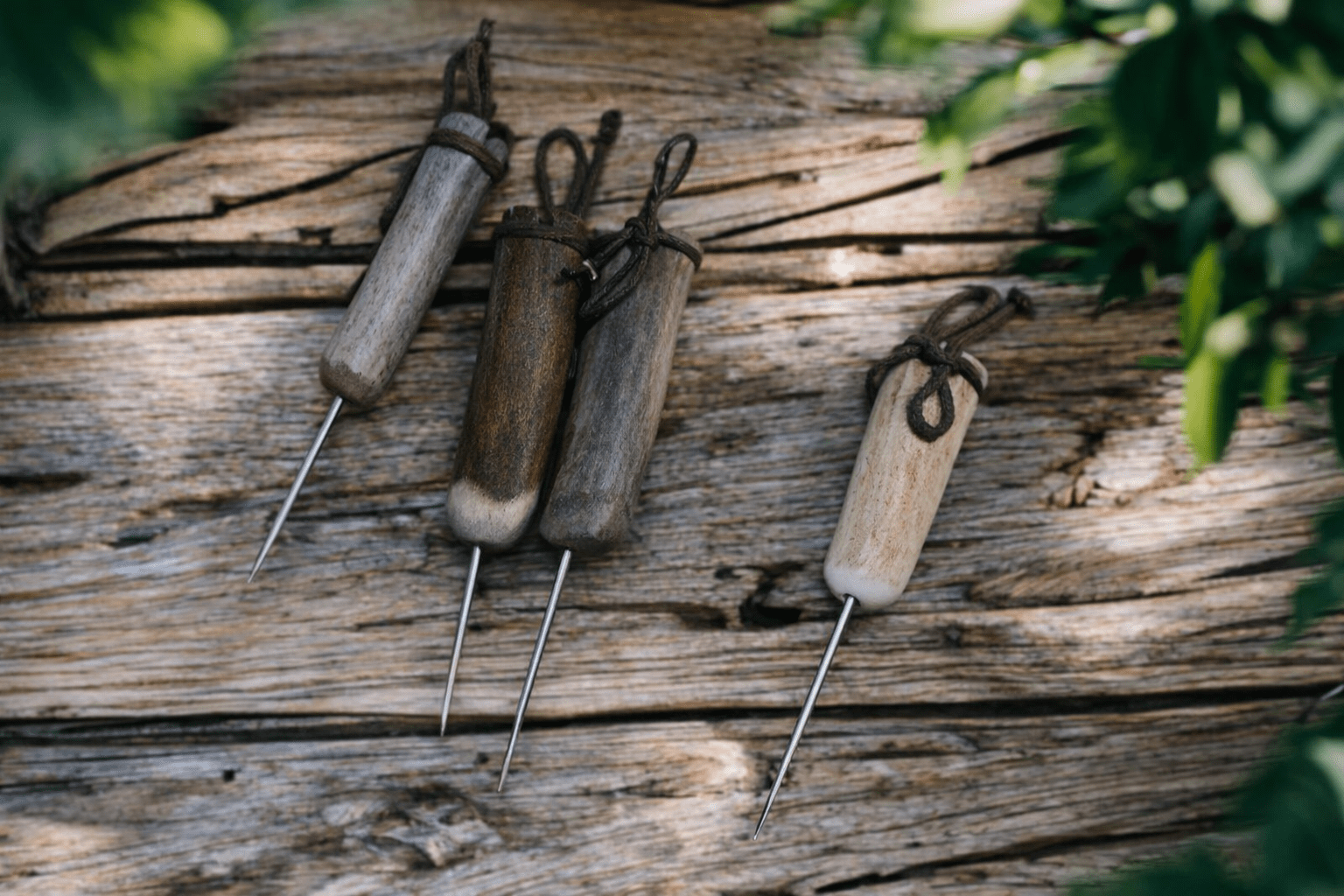
Needle holder from a reindeer horn
I have also made my own felting needle holders. They are not ordinary mass-produced tools, but handmade objects that combine practicality and aestheticism. In addition to the holder, they also include a protective case for the needle. Such an ensemble is intended for the person who uses the tool on a daily basis and appreciates both functionality and a carefully made object.
Why felting needles sometimes break
Felting needles are made of hard, but at the same time rather brittle steel. As a result, they can break if used at the wrong angle.
The most common causes of needle breakage are:
- twisting the needle inside the wool
- pulling the needle to the side
- the needle hits a hard surface
Therefore, an important rule is that the needle always moves straight up and down.
Why a needle sometimes tears wool
Sometimes it can feel as if the needle is tearing the wool instead of felting it. This may be because, for example, the work is already very dense and the needle is too coarse. Once the wool is felted, the fibres do not move easily. In this case, it is worth switching to a thinner needle. The structure of the wool also has an influence. If the fibre is very long or smooth, the needle may pull the fibres out before they have time to bind properly to the structure.
Why holes appear in the work
Holes are often created when the same spot is stabbed for a long time with a single needle. The needle moves the fibres away from one point, which can create a small hole.
In this case, it can help:
- add a little wool to the point
- work in a wider area
- use a thinner needle for finishing.
How to know if the job is sufficiently swollen
Sufficiently felt work feels dense and elastic. When you press the surface with your finger, it no longer presses together easily.
The needle also starts to move a little more heavily in the wool, because the fibres are already locked together. This is often a sign that the structure is already tight enough and the work is ready for the finishing stage.

Quilting is a skill that is developed first and foremost by doing. The more you work with wool and needles, the better you will get to know the behaviour of the material and the possibilities of the tools. Gradually, your movement becomes more confident, your work more relaxed and your ideas become easier and easier to realise.
It's good to remember that every job teaches you something new. That's why it's worth being brave enough to experiment with different needles, thicknesses and ways of working. Over time, you will find the tools and techniques that best suit your own way of working.
If you want your learning to be faster and progress clearly step by step, you are warmly you are also welcome to join my felting school.
As you keep practising, you will gradually discover how felting becomes more and more natural and how small wool fibres can be used to create completely new shapes, textures and patterns.
Let us know your thoughts and wishes: